Phoenix, Arizona

Making the complex clear and the hidden accessible.

Physician. Writer. Teacher. A place to share work that has mattered to me, for anyone it might help.

FB
Physician & Writer
The Expressed Life

A Field Guide for Living From the Inside Out

The Expressed Life is a field guide for anyone asking the questions that won't go away: who am I underneath what I have built and performed, what am I actually made for, and what does it take to keep the fire burning across every season of a life. It is especially for the person who has felt lost, bounced between directions by circumstance, or carried by whatever wind happened to be blowing, and who is beginning to sense that the answers they spent years searching for outside themselves were inside all along. Drawing on James Hollis, Eric Butterworth, and Jim Collins, three frameworks that were never meant to meet, it is designed to be worked through slowly, returned to at every major transition, and used as a compass when the ground changes under your feet.

Fourteen lessons. One workbook. Your responses stay in your browser, private, never transmitted, never seen by anyone but you.

01
Jim Collins
How Lives Actually Unfold
Encodings. Cliffs. Fog. NATILIE moments. The empirical research on how real lives develop, not how they are supposed to, but how they do. Collins describes the weather.
02
Eric Butterworth
Spiritual Economics
Inner conditions producing outer experience. Syntropy. The giving principle. Divine discontent as the engine of authentic movement. Butterworth describes the greenhouse.
03
James Hollis
The Examined Life
Identity. The provisional self. The question that will not go away. Individuation. Hollis asks who is inside the greenhouse, and whether that person was freely chosen.
04
Neville Goddard
Feeling is the Secret
The mechanism underneath everything else. Feeling is the only medium through which ideas reach the subconscious. Sleep is the natural gateway. Neville describes how to tend the greenhouse deliberately, night by night, through the one faculty that reaches the subconscious directly.

"Collins describes the weather. Butterworth describes the greenhouse. Hollis asks who is inside it and whether that person was freely chosen. Neville describes how to tend it, night by night, through feeling. None of these authors reference each other. The connections between their frameworks are original to this curriculum."

The 13 Lessons
1The Greenhouse
2The Constellation
3The Identity
4The Cliff
5The Fog
6The Punch Card
7Return on Luck
8The NATILIE Moment
9Simplex Stepping
10Extend Out / Circle Back
11The Roulette Wheel
12Capabilities Compound
13Catalytic Questions
14The Night Practice
15The Four Seasons

Your workbook responses are stored only in your browser's local storage. Nothing is transmitted. Nothing is saved to a server. No account required.

Enter the Field Guide
Daily Practice

Spiritual Economics, practiced daily

Eric Butterworth and Neville Goddard, practiced daily. A morning centering, a daily study, an evening review, and a night practice drawn from Neville's sleep protocol. The inner work, made into a daily rhythm.

"His work doesn't flatter the reader or offer easy resolution. It insists that the questions worth asking are the ones that disturb, that surface what has been buried, that refuse to let you stay comfortable in an identity that was assembled rather than discovered." On James Hollis, from the Expressed Life overview
Books

Written Work

Published
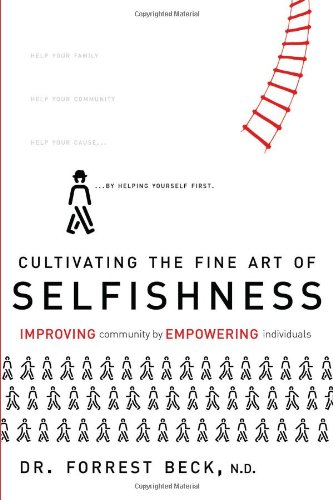
Cultivating the Fine Art of Selfishness by Forrest Beck

Cultivating the Fine Art of Selfishness is a book for caregivers: physicians, parents, partners, anyone who gives of themselves as a matter of identity. The argument is precise and clinical: you cannot give what you have not first maintained in yourself.

The same framework that underlies the Expressed Life curriculum, arrived at independently through medical practice rather than philosophy. Which is evidence that it is true.

In Development
Children's Book Series
Forrest Beck

A boy genius who can't stop blurting out whatever his brain is thinking travels the country in a tricked-out motorhome, solving mysteries with a gadget vest full of real-world technology and a shortwave radio he trusts more than any app. Each book drops him into a new city, a new problem, and a new kid who needs help that only he can provide.

The series is built for children who are ready for more than a screen can give them. Every gadget is rooted in technology that actually exists, and a True or False section at the end of each book lets kids test how much of the adventure was closer to reality than they imagined. The heroes solve problems by paying attention, trusting their instincts, and working together, and no gadget ever gets credit for what a kid figured out on their own.

About

Forrest Beck

I am a physician, NMD, and the founder and Medical Director of Beck Medical Group, a concierge and corporate medicine practice based in Phoenix. That is what I do professionally. It is not the whole of what I am built to do.

Some books inform you. A few change you. I have been changed by several, and I want to talk about them honestly: not as a reading list, but as a map of a particular journey.

Peter Diamandis's Abundance moved me from cynicism to what I now call optimal realism. I adopted the language of abundance quickly, almost overnight. But I came to recognize that most of what I was thinking about was external: resources, money, opportunity. The internal work was still ahead of me.

It arrived, as these things often do, through difficulty. During one of the harder seasons of my life, I found Stoicism. It gave me an operating system when I needed one most. I have practiced it daily since.

As I continued working through that season, I found James Hollis. His work, rooted in Jungian psychology, was the closest thing I have experienced to a wise elder sitting across from me and telling me the truth. He helped me understand myself in ways that were, without exaggeration, life-saving.

A close friend then recommended Eric Butterworth's Spiritual Economics. I will always be grateful for that. Where Diamandis had pointed me toward external abundance, Butterworth helped me understand that if you get the internal state right: the framing, the flow, the orientation, everything changes. I am not a religious person, but this book asked me to tend to something I had long neglected. I think of it as the Universe. Others call it God. The name matters less than the practice.

Shortly after, I read Jim Collins's most recent work. I believe we find the books we need when we need them. Collins helped me see my encodings more clearly: that they can evolve, that some are still waiting to be discovered, and that my hardest seasons have often been the ones where I was living out of alignment with them.

These four works, separately significant and together transformative, led me to want to build something. They fit together in ways none of their authors anticipated. I wanted to map those connections.

If you are navigating a cliff, a fog, a transition you did not choose, or a question about who you actually are apart from what you have built and performed, I hope there is something helpful here for you.